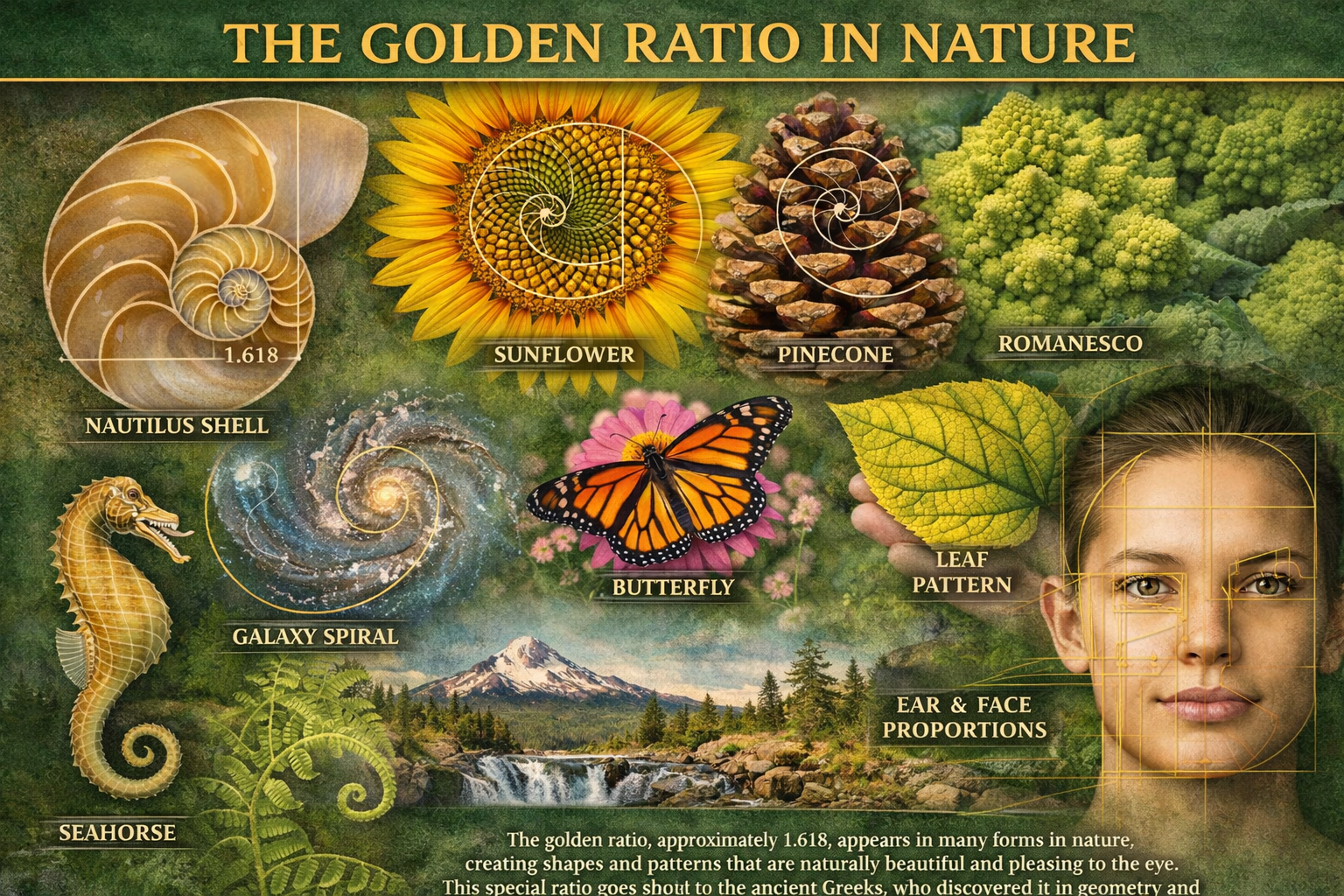
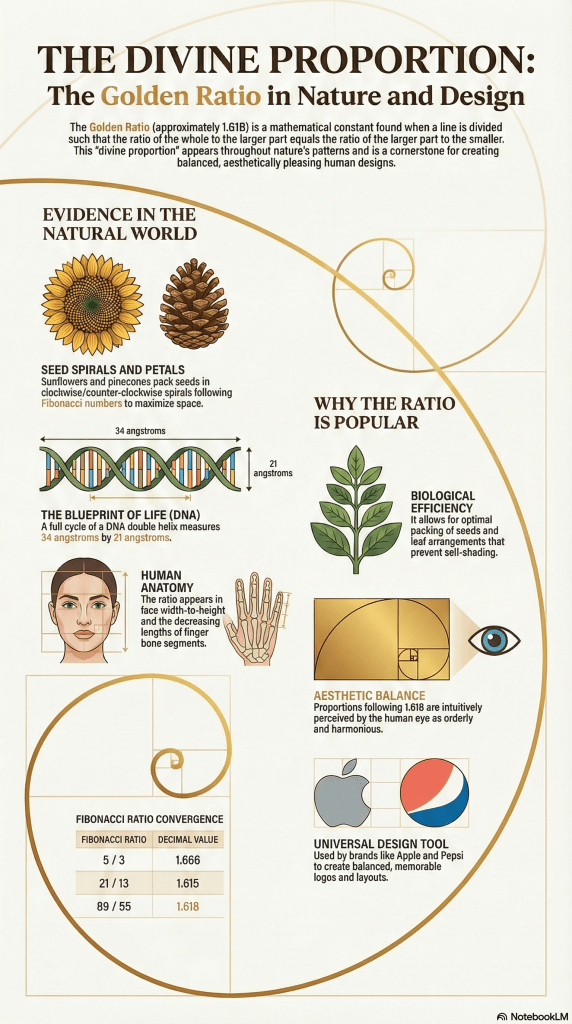
The golden ratio (1.618) and Fibonacci sequence describe mathematical patterns found in nature, from sunflowers to DNA. While vital in UX design, music, and geometry, scholars debate its historical use in Greek architecture, labeling some claims of “divine” beauty as myths.
The golden ratio is popular because it appears to create shapes and proportions that humans naturally find balanced, harmonious, and visually pleasing. Our brains are very good at recognizing patterns, and the golden ratio shows up repeatedly in nature—plants grow efficiently using spiral patterns, animals develop proportional body parts, and even galaxies form spiral shapes that resemble it. Because this ratio often results from efficient growth and space optimization, it became associated with beauty, balance, and perfection. Artists, architects, and designers adopted it over time because works that follow the golden ratio tend to feel “right” to the human eye, even if people can’t explain why.
The golden ratio was discovered through mathematics, not art. Ancient Greek mathematicians, especially Euclid (around 300 BCE), first described it while studying geometry and line segments. They noticed that when a line is divided so that the ratio of the whole to the longer part equals the ratio of the longer part to the shorter part, a special number appears—approximately 1.618. Much later, mathematicians realized this same number emerges when dividing consecutive numbers in the Fibonacci sequence, which helped explain why the ratio shows up so often in natural growth patterns. Over centuries, this mathematical curiosity evolved into one of the most famous connections between math, nature, and beauty.
Cheers!! ❤
For Registration : Click here
SAT | ACT | ASVAB | GED | TEAS | ACCUPLACER | FTCE | SELF-LEARNING
📞 Call us now at 860-997-2916 to schedule your session
📍 Visit us at 3093 A Cleveland Ave, Fort Myers, FL 33901
Sharma & Sharma Tutoring Services
Private Tutoring & Exam Prep Services
http://www.mathtutorofflorida.com
 Sharma & Sharma